Free Printable Addition Worksheets
Generators covering the full Grades 1–4 addition progression — single-digit facts, 2- and 3-digit, with and without regrouping, fact families, and word problems. All free, all with answer keys, all aligned to Common Core State Standards.
Addition is the first operation children learn and the foundation every later math skill builds on. It starts in Kindergarten (adding within 5, then 10) and runs through Grade 4, where students fluently add multi-digit numbers using the standard algorithm. The single most-practiced Grade-3 addition standard is CCSS 3.NBT.A.2 — "fluently add and subtract within 1000" — which every teacher assigns weekly. The tools here cover that whole arc: single-digit facts for Grade 1, 2-digit work for Grade 2, regrouping (carrying) for Grade 2–3, and 3-digit addition within 1000 for Grade 3.
Every tool is a generator, not a static PDF. You get infinite fresh problem sets, a seeded 6-character code that reproduces any exact worksheet, and a single-page print guarantee — 20 problems or 100, it always fits one clean 8.5×11 sheet with an optional answer key. The free competitors (Math-Aids, K5 Learning, Super Teacher Worksheets) hand you the same fixed PDFs forever; these regenerate on every reload with full control over digit count, regrouping, problem count, and layout. No signup, no email gate, no watermark.
The research-backed practice pattern is 10–20 problems a day rather than one long weekly session (Foorman 2016 IES practice guide; Rohrer & Taylor 2007 on session length). Lead with mental-math strategies — make-ten, doubles, and near-doubles — before pushing the standard written algorithm, so regrouping rests on real number sense rather than a memorised procedure. Pair daily practice with fact-family triangles so addition and subtraction are learned together as inverses.
Pick the right addition worksheet
Grouped from first facts to multi-digit. Start at the top if you're early in the year; jump to regrouping if that's the specific skill you're practising.
 Start here
How addition is taught, K through Grade 4
The standard progression most curricula follow, and how the tools map to each stage.
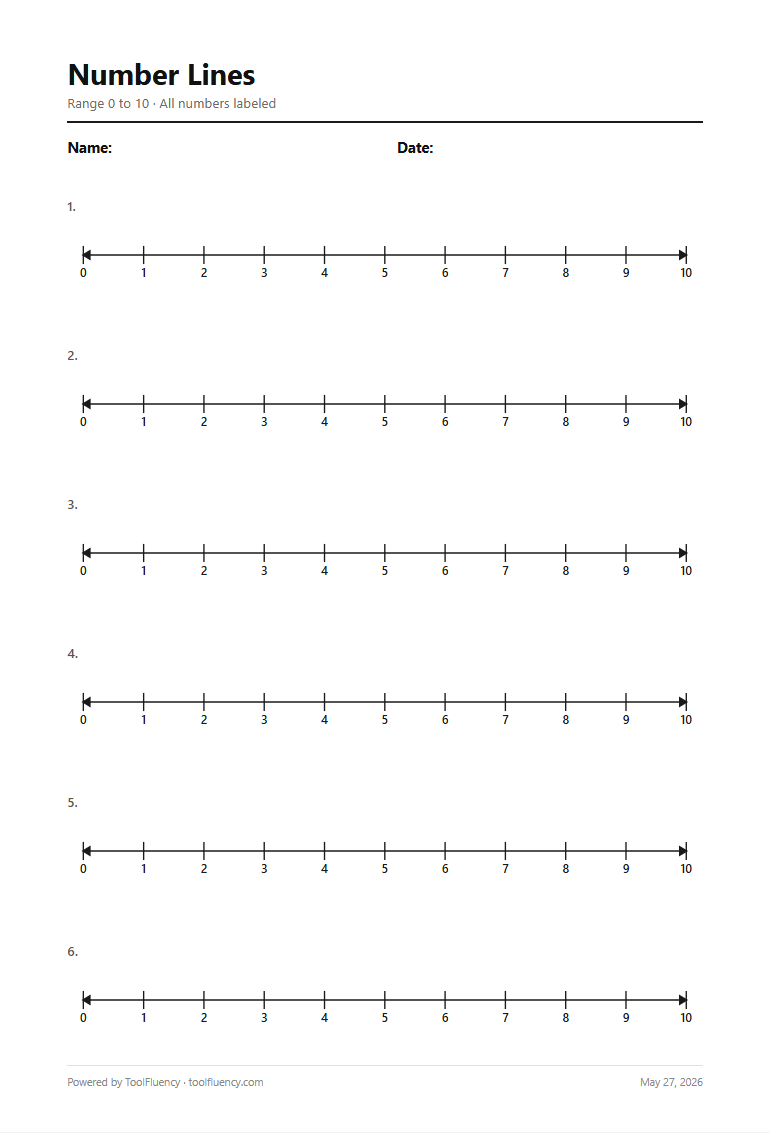
- Counting on & addition within 10 (K–Grade 1). Children start by counting all, then "counting on" from the larger number. Use number lines to make the hops visible, and the addition generator set to single-digit for fact practice. CCSS 1.OA.C.6.
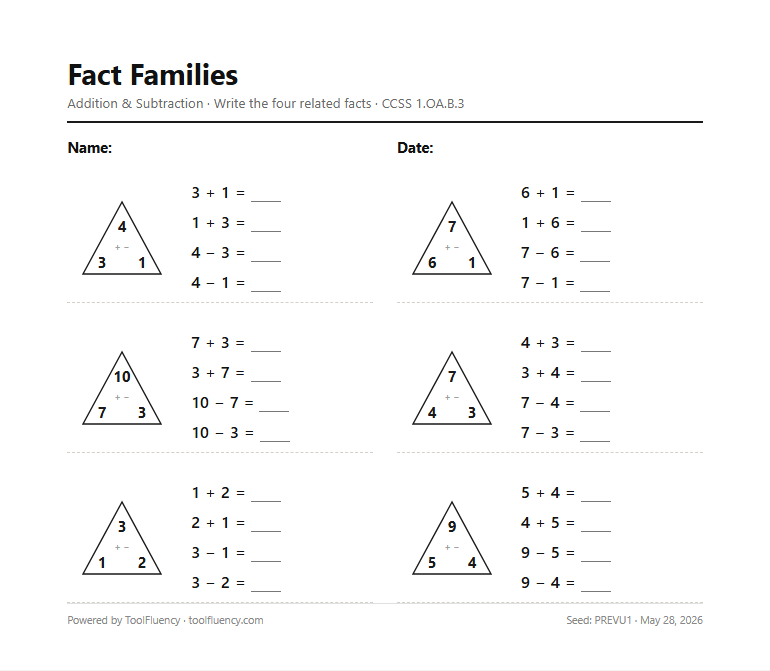
- Make-ten & doubles strategies (Grade 1–2). The key mental-math moves: 8 + 5 becomes 8 + 2 + 3 = 13 (make-ten); 6 + 7 becomes 6 + 6 + 1 (near-double). These strategies, not rote memorisation, are what cognitive-load research supports for durable recall. Pair with fact families so subtraction comes along for free.
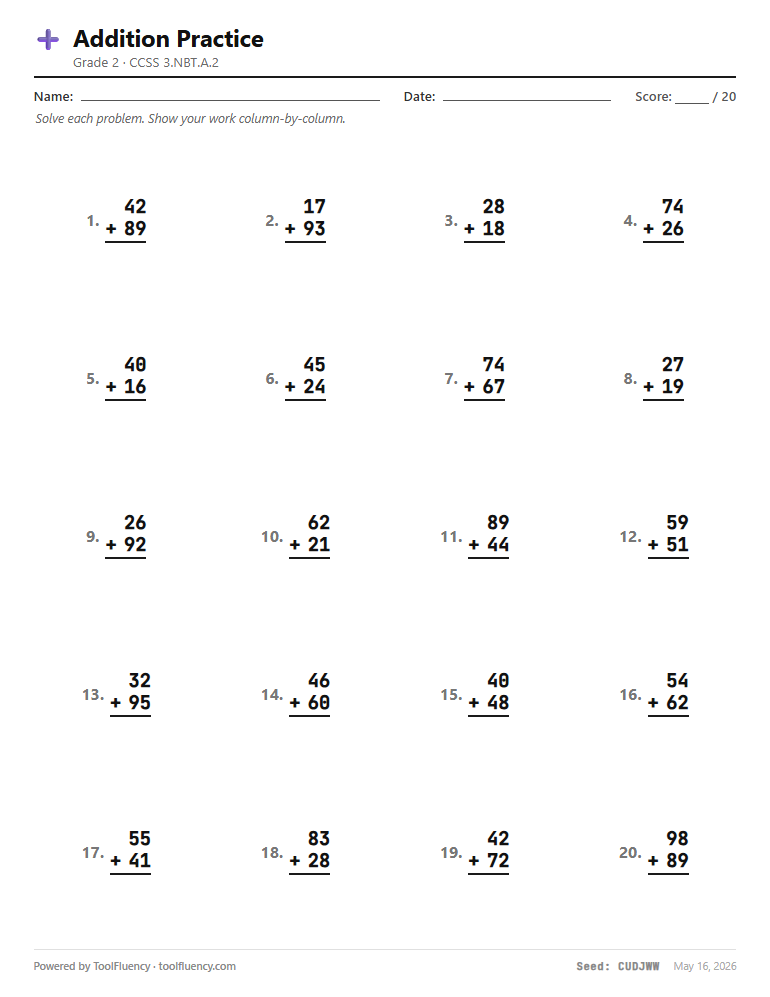
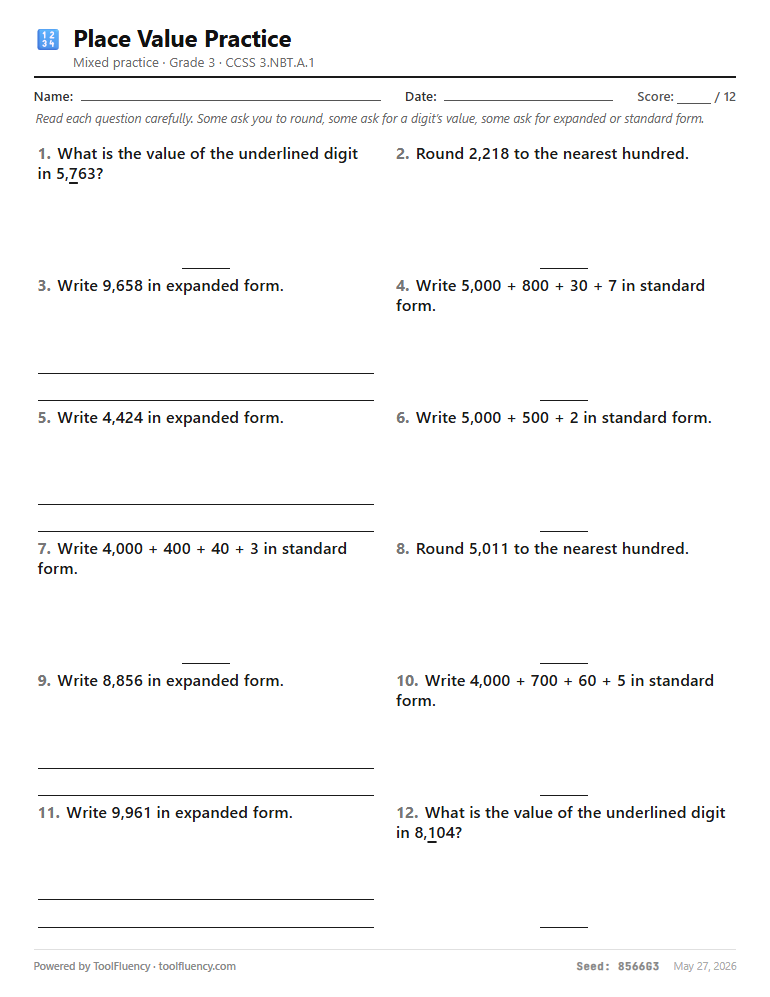
- 2-digit, no regrouping (Grade 2). Add tens and ones separately when no carrying is needed (34 + 25). This cements place-value alignment before the harder regrouping step. Use the addition generator at 2-digit with regrouping off.
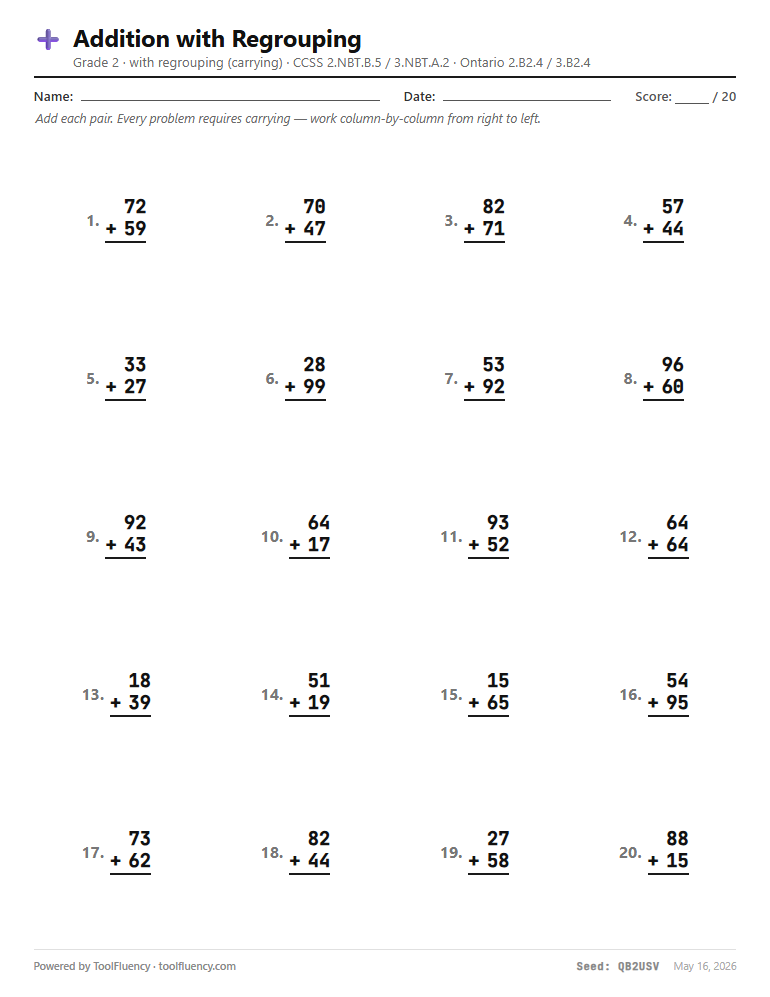
- Regrouping / carrying (Grade 2–3). The conceptual leap: when a column sums past 9, carry a ten. Anchor it in expanded form so students see that carrying is just renaming ten ones as one ten. Use the dedicated regrouping worksheet, where every problem requires it.
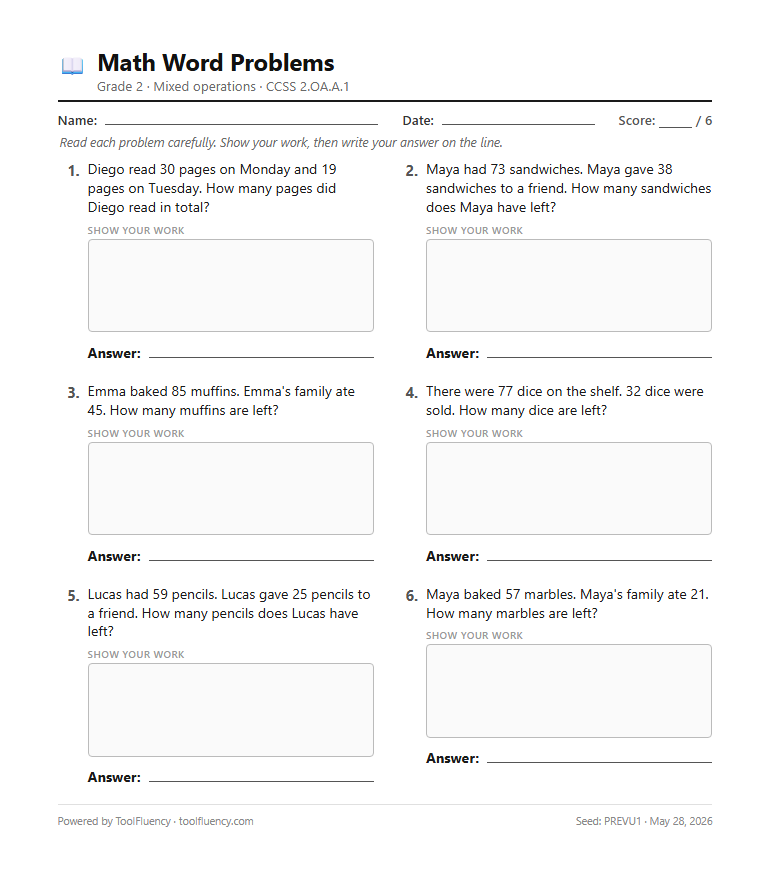
- Addition within 1000 (Grade 3). CCSS 3.NBT.A.2 — fluently add 3-digit numbers with multiple regroupings. The addition generator at 3-digit is the core homework tool here. Reinforce with word problems so the skill transfers to real contexts.
- Multi-digit fluency (Grade 4). Larger numbers, more regroupings, and addition embedded in multi-step problems. Continue the generator at 4-digit and lean on word problems for the multi-step standard (4.OA.A.3).
Common questions about addition worksheets
What parents and teachers ask first.