Free Printable Multiplication Worksheets
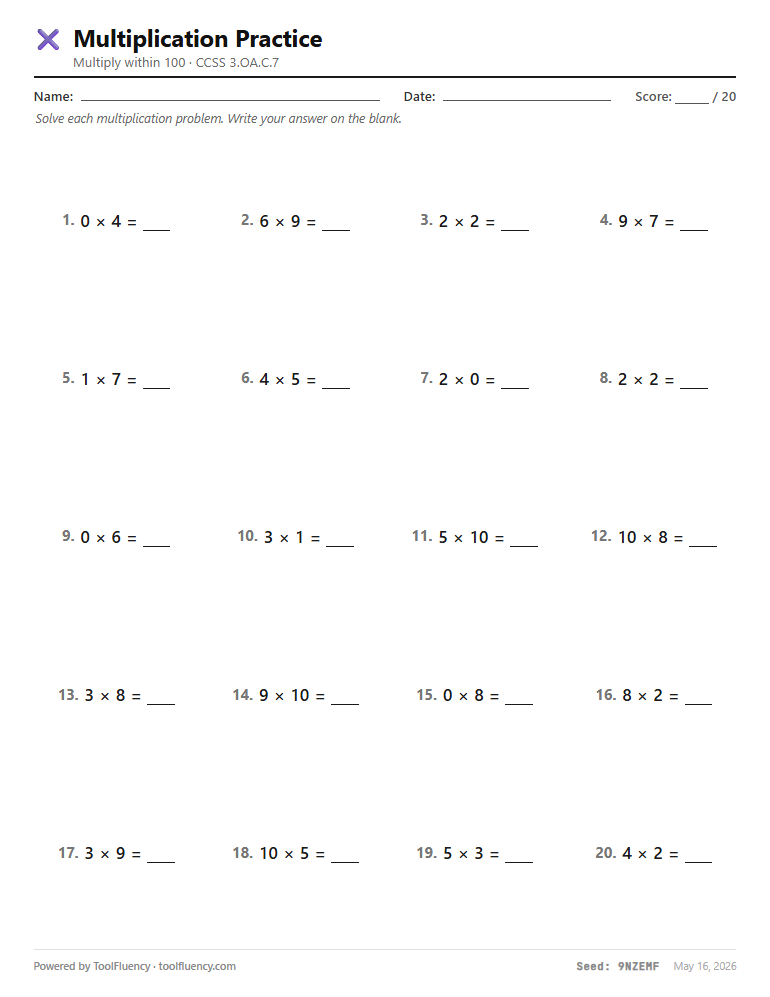
Seven generators covering the full Grade 3-5 multiplication progression — anchor facts, tier-2 facts, the full chart, Mad Minute drill, missing factor practice, and multi-digit. All free, all with answer keys, all aligned to Common Core State Standards.
Multiplication is the marquee Grade 3 math skill — CCSS 3.OA.C.7 requires fluency with multiplication and division within 100 by the end of the year. Most kids start the year not knowing their times tables and end it expected to recall any single-digit fact in under three seconds. That progression happens through structured, repeated practice across a specific sequence of difficulty: anchor facts first, tier-2 facts second, the hardest facts (6s, 7s, 8s) last, then timed fluency drills, then multi-digit. The seven tools here are designed to match that sequence exactly.
Every tool is a generator, not a static PDF. That means infinite variation, seeded reproducibility (a 6-character code in the footer reproduces any exact problem set), and a single-page layout guarantee — whether you choose 20 problems or 100, the worksheet always prints to one clean 8.5×11 page. The competing free sites (Math-Aids, K5 Learning, Super Teacher Worksheets) show you the same 15 PDFs forever; these tools give you a fresh problem set every reload, with full control over fact range, problem count, layout, and whether to print the answer key. No signup required, no email gate, no watermark.
The recommended use pattern: 10-15 minutes of daily practice during the multiplication unit (Foorman 2016 IES practice guide; Rohrer & Taylor 2007 on retrieval-practice session length). Pair the worksheet with a brief flashcard warm-up. Use the Mad Minute drill weekly as a fluency benchmark — the goal is steady improvement, not a fixed score. By spring, most Grade 3 students hit the end-of-year standard.
Pick the right worksheet
Grouped by where they fit in the Grade 3 teaching sequence. Start at the top if you're early in the year; jump to drills if you're prepping for end-of-year fluency.
 Start here
 Most popular
How to teach the times tables
Decades of math-education research point to a specific order for introducing multiplication facts. Here's the sequence most curricula follow and how the tools here map to each phase.
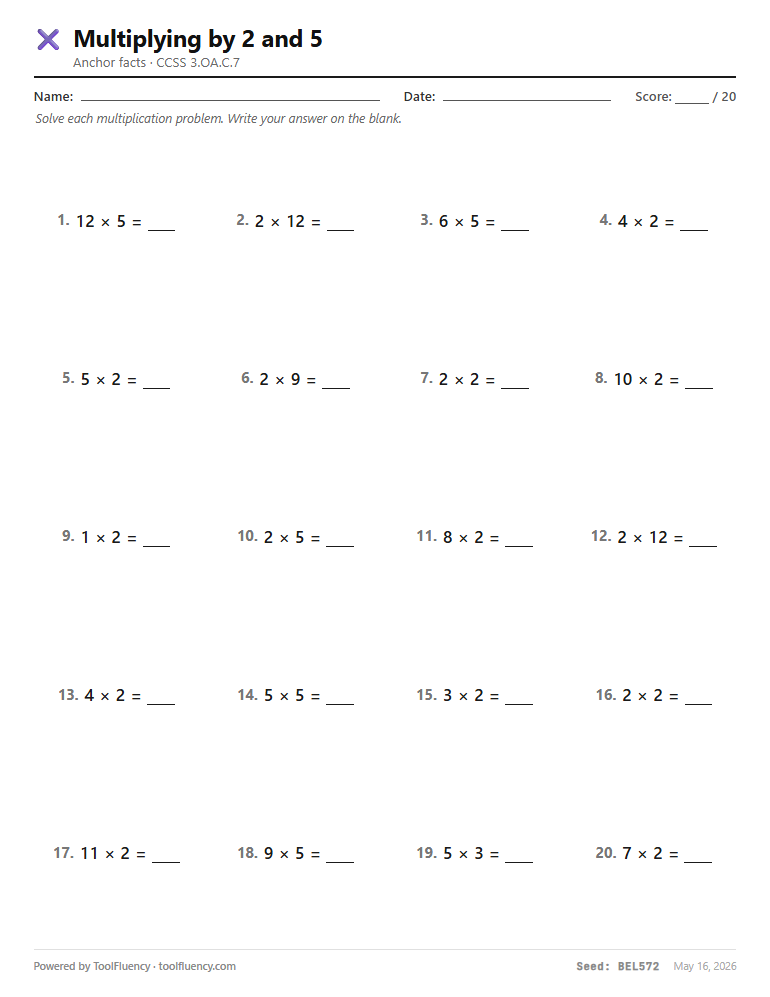
- Anchor facts: 2s, 5s, 10s. Start here — kids already skip-count these from kindergarten, so the multiplication is just renaming what they know. Roughly 40% of the times table is in this group. Use Multiplying by 2 and 5 for daily practice. 10s are usually trivial once kids see the pattern (5 × 10 = 50, 8 × 10 = 80) so most curricula don't dedicate a separate worksheet to them.
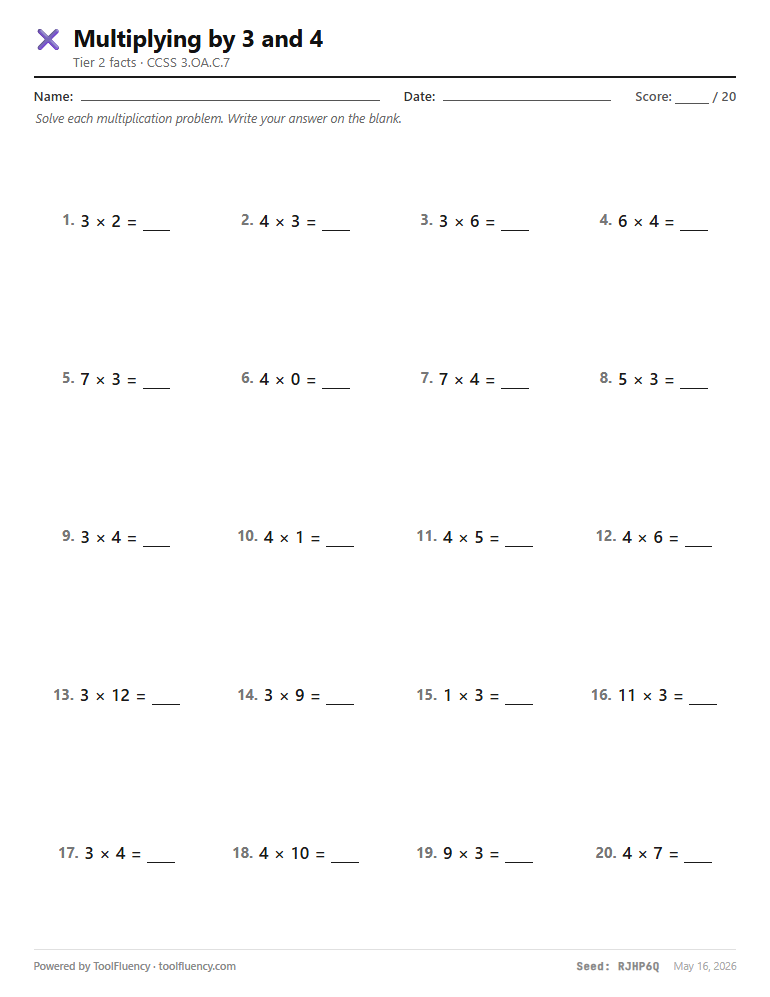
- Tier-2 facts: 3s, 4s. Each builds on an anchor: 3 is "2 plus 1 group of" (so 3×6 = 2×6 + 6 = 18), 4 is "doubles of doubles" (so 4×7 = double of 2×7 = 14+14 = 28). Use Multiplying by 3 and 4. By the end of this phase students have ~70% of the times table.
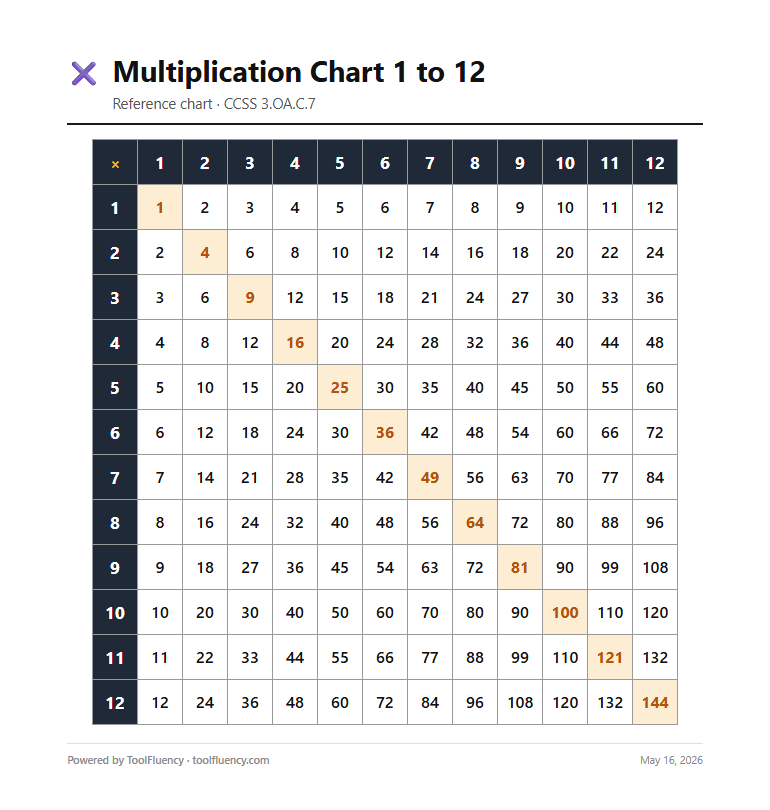
- Hardest facts: 6s, 7s, 8s. These are the ones every parent remembers struggling with. The 9s have a finger trick (or "10s minus the number"). The 7s have no shortcut and are usually saved for last. Most curricula introduce these one at a time, with explicit strategy instruction. The general multiplication worksheet generator (set to 10×10 range) is the right tool for cycling through these.
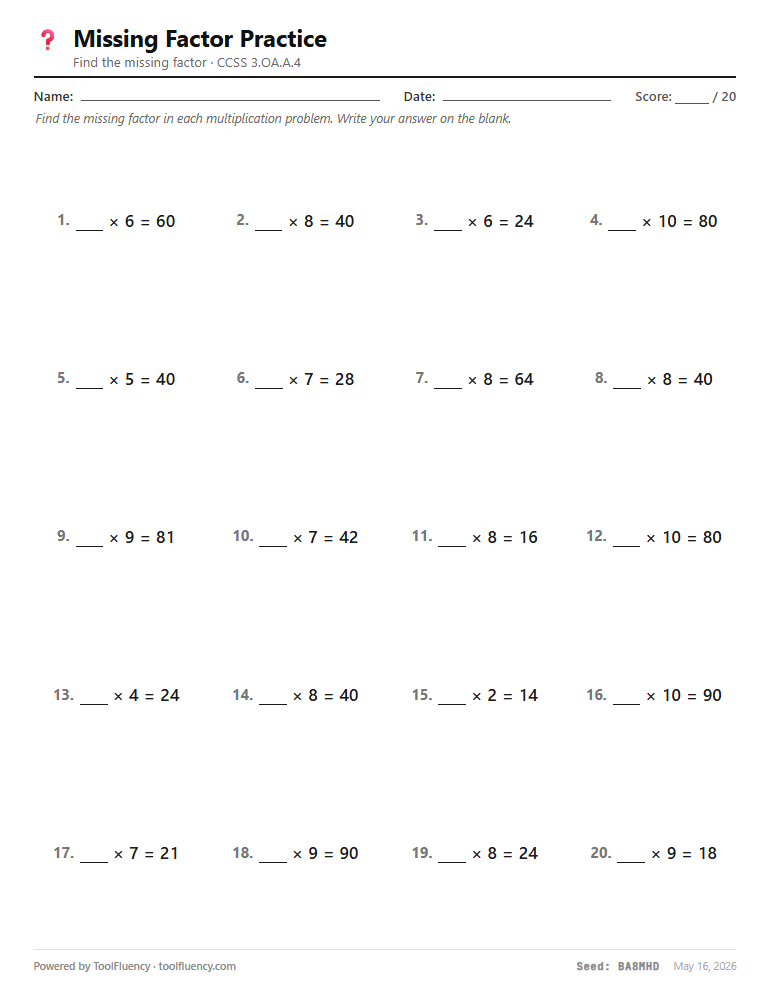
- Inverse thinking: missing factors and division. Once forward recall is fluent, students need the inverse: given the product, find the factor (CCSS 3.OA.A.4). Use the missing factor worksheet. This is the bridge to division — the next major skill — and is critical for fraction and algebra readiness later.
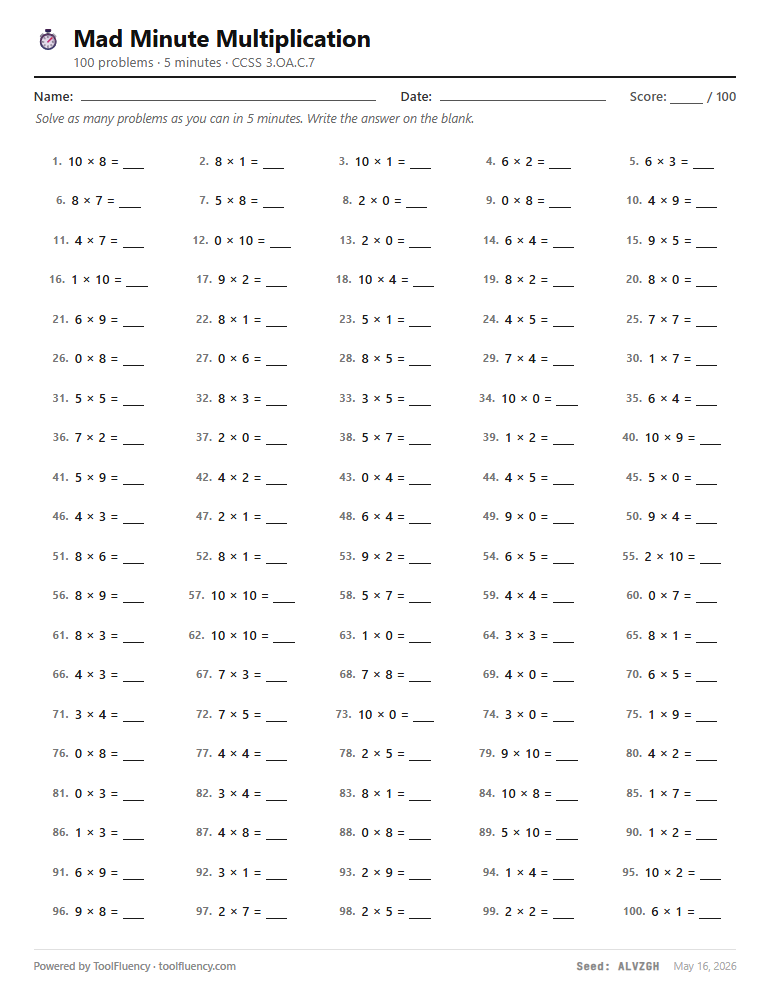
- Timed fluency drill: Mad Minute. Print the Mad Minute weekly starting around January. The goal is steady improvement over the semester, not a fixed score. Most curricula target 100 problems in 5 minutes for an end-of-Grade-3 fluency check (3.OA.C.7).
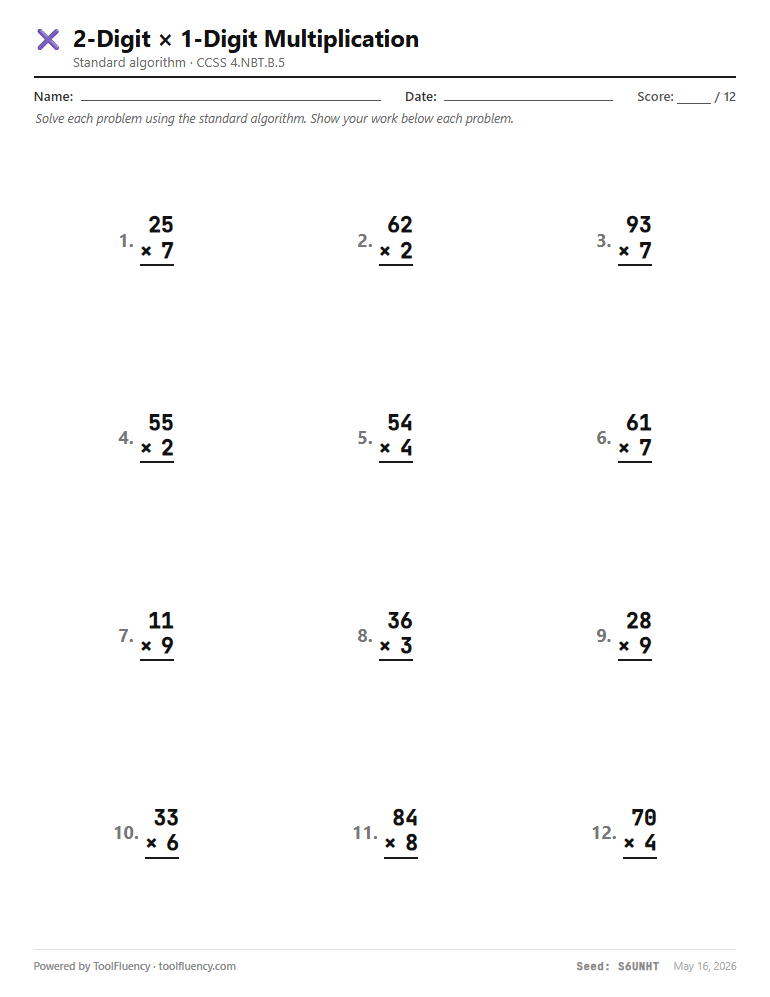
- Multi-digit standard algorithm (Grade 4). Once single-digit facts are fluent, Grade 4 introduces 2-digit × 1-digit multiplication with regrouping (4.NBT.B.5). Use the 2-digit by 1-digit worksheet. This is the foundational column algorithm that scales into 3-digit by 2-digit and beyond in Grade 5.
Common questions about multiplication worksheets
What parents and teachers ask first.