Free Printable Division Worksheets
Generators covering the full Grades 3–5 division progression — basic facts, division with remainders, long division, fact families, and word problems. All free, all with answer keys, all aligned to Common Core State Standards.
Division is the inverse of multiplication and the last of the four operations students master. It's introduced in Grade 3 as equal sharing and grouping (CCSS 3.OA.A.2), tied tightly to the multiplication facts (3.OA.C.7 covers multiply and divide within 100), then extends to division with remainders and the long-division algorithm in Grade 4 (4.NBT.B.6). The tools here cover that whole arc: basic facts for early Grade 3, remainders for late Grade 3–4, and full long division for Grade 4–5.
Every tool is a generator, not a static PDF — infinite fresh problem sets, a seeded 6-character code that reproduces any exact worksheet, and a single-page print guarantee with an optional answer key. Pick basic facts, facts-with-remainders, or long division; set the divisor range and problem count; print the student copy and a matching key. No signup, no email gate, no watermark.
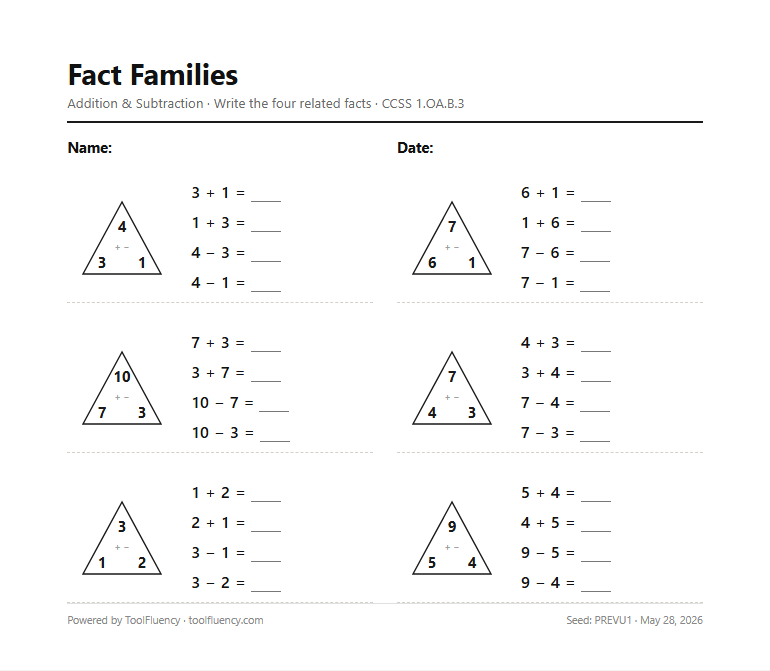
The single most important idea: division is multiplication in reverse. A child who knows 6 × 7 = 42 already has 42 ÷ 6 = 7 and 42 ÷ 7 = 6 — that's the "think-multiplication" strategy and the reason fact families teach the two operations together. Make sure multiplication facts are fluent before pushing division speed; division built on shaky times-tables is the #1 source of Grade-4 frustration. Keep daily practice to 10–20 problems.
Pick the right division worksheet
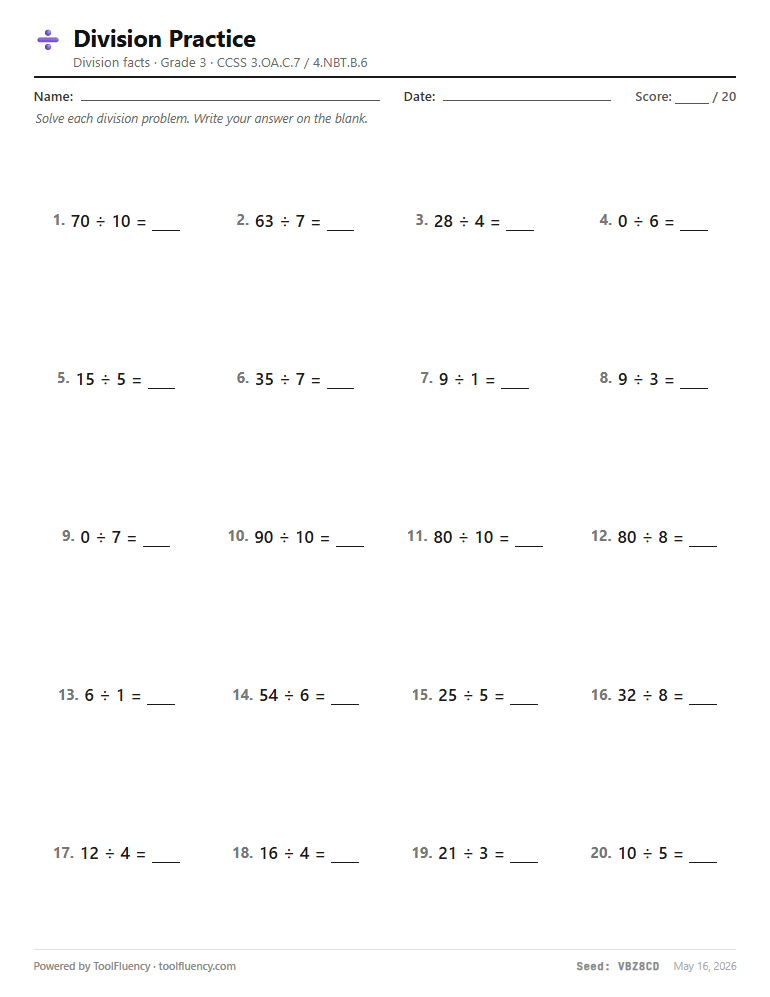
From basic facts to long division. The main generator covers all three modes — facts, remainders, and long division.
 Start here
How division is taught, Grade 3 through Grade 5
The standard progression most curricula follow, and how the tools map to each stage.
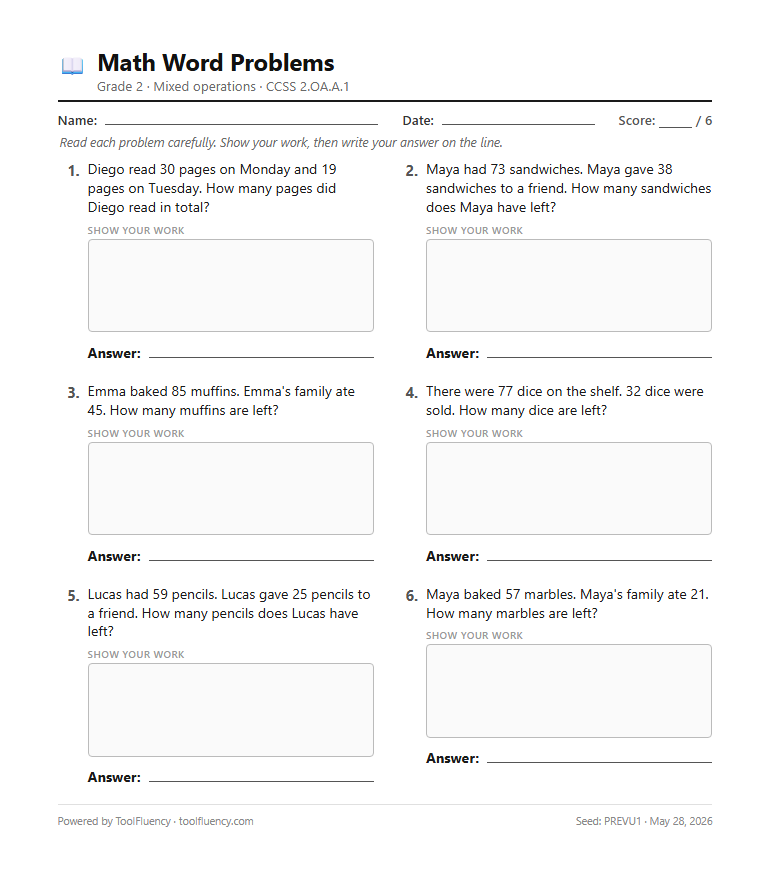
- Sharing & grouping (early Grade 3). Division starts concrete: "share 12 cookies among 3 friends" (partitive) and "how many groups of 3 in 12?" (quotative). Use division word problems to ground both meanings before symbols. CCSS 3.OA.A.2.
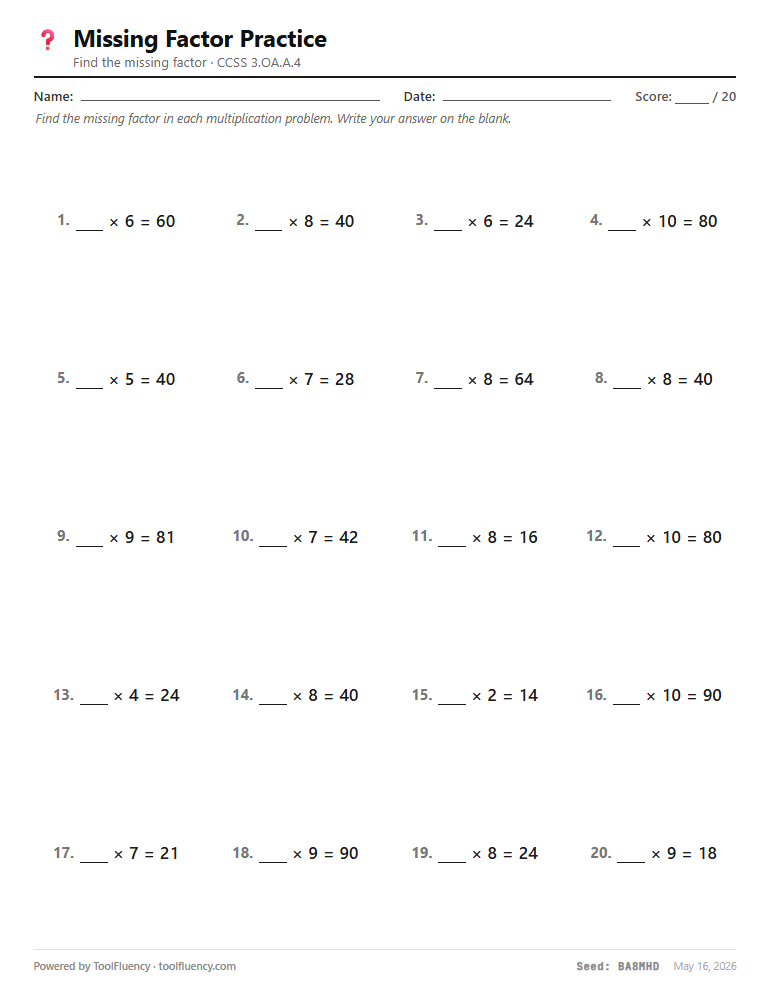
- Division as inverse of multiplication (Grade 3). Connect every division fact to a known multiplication fact. Fact families and the missing-factor worksheet build the "think-multiplication" strategy: to solve 42 ÷ 6, think "6 times what is 42?"
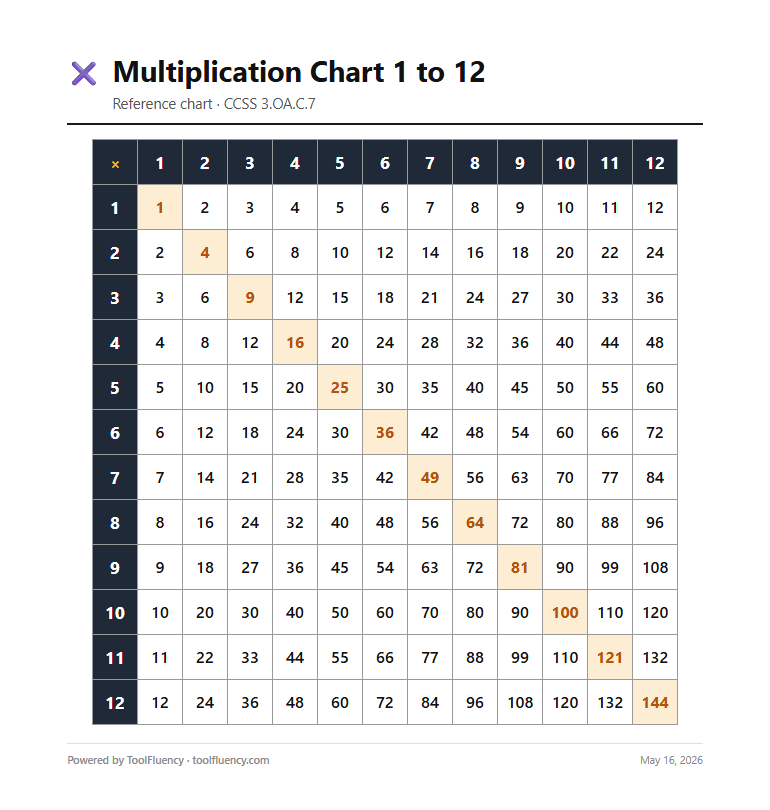
- Basic division facts (Grade 3). Fluency with ÷1 through ÷10, mirroring the times tables (3.OA.C.7). Use the division generator in facts mode. The multiplication chart is a useful scaffold while facts are forming.
- Division with remainders (late Grade 3–4). Not everything divides evenly. Introduce remainders, then the harder skill of interpreting them in context (does a remainder mean "round up", "drop it", or "the answer is the remainder"?). Generate facts-with-remainders problems and pair with word problems.
- Long division (Grade 4). The standard algorithm — divide, multiply, subtract, bring down — for dividing multi-digit numbers by a single digit (4.NBT.B.6). Use the division generator in long-division mode, which lays out the bracket and work space.
- Multi-digit divisors (Grade 5). Long division extends to 2-digit divisors (5.NBT.B.6). Same algorithm, larger numbers and more estimation. Continue the long-division mode at the higher divisor range.
Common questions about division worksheets
What parents and teachers ask first.