Free Printable Subtraction Worksheets
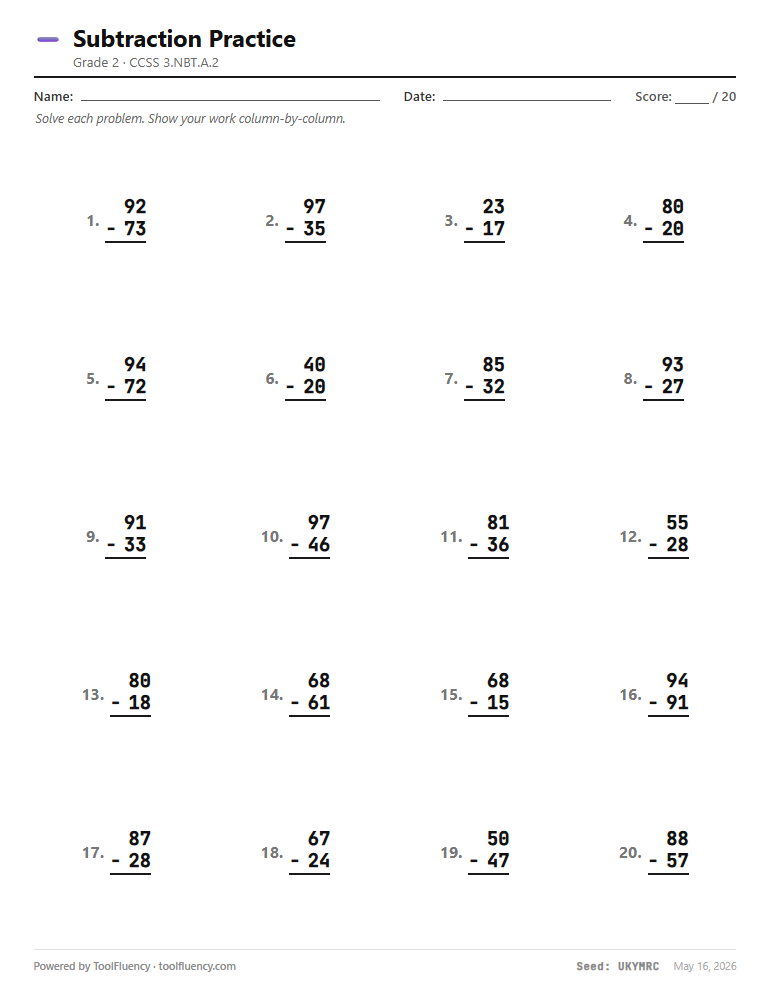
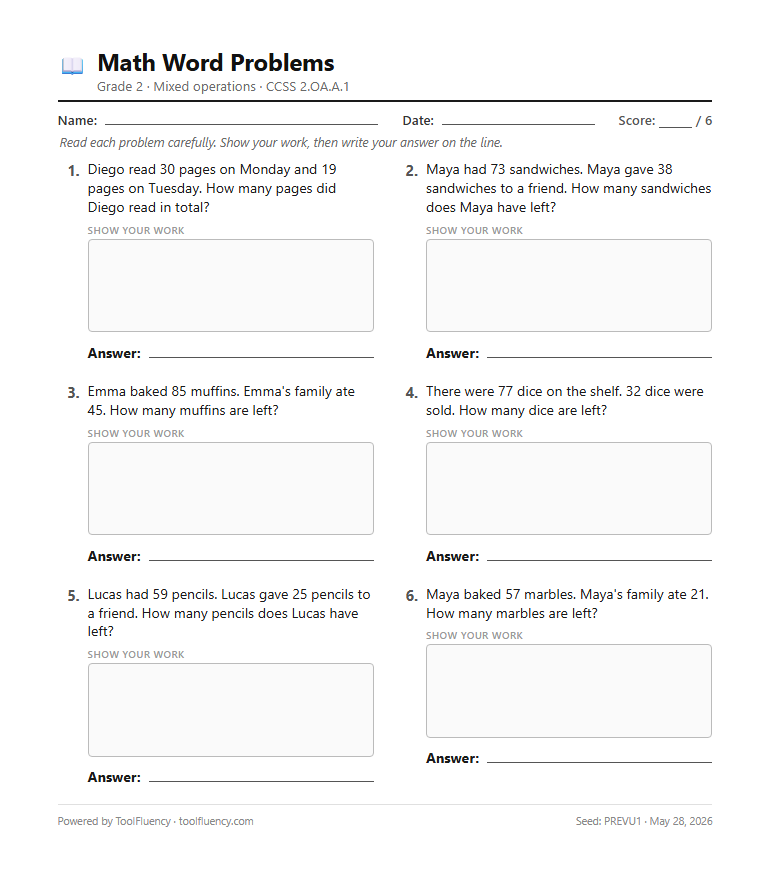
Generators covering the full Grades 1–4 subtraction progression — single-digit facts, 2- and 3-digit, with and without borrowing, fact families, and word problems. All free, all with answer keys, all aligned to Common Core State Standards.
Subtraction is the inverse of addition, and the two are taught hand in hand. It begins in Kindergarten (taking away within 5, then 10) and runs through Grade 4 multi-digit work. The big Grade-3 standard is CCSS 3.NBT.A.2 — "fluently add and subtract within 1000" — which pairs subtraction directly with addition in the same expectation. The tools here cover the whole arc: single-digit facts in Grade 1, 2-digit subtraction in Grade 2, borrowing (regrouping) in Grade 2–3, and 3-digit subtraction within 1000 in Grade 3.
Every tool is a generator, not a static PDF — infinite fresh problem sets, a seeded 6-character code that reproduces any exact worksheet, and a single-page print guarantee with an optional answer key. The borrowing toggle lets you choose no-regrouping problems for early practice or guaranteed-borrowing problems when that's the specific skill. No signup, no email gate, no watermark — the clean alternative to the dated free worksheet sites.
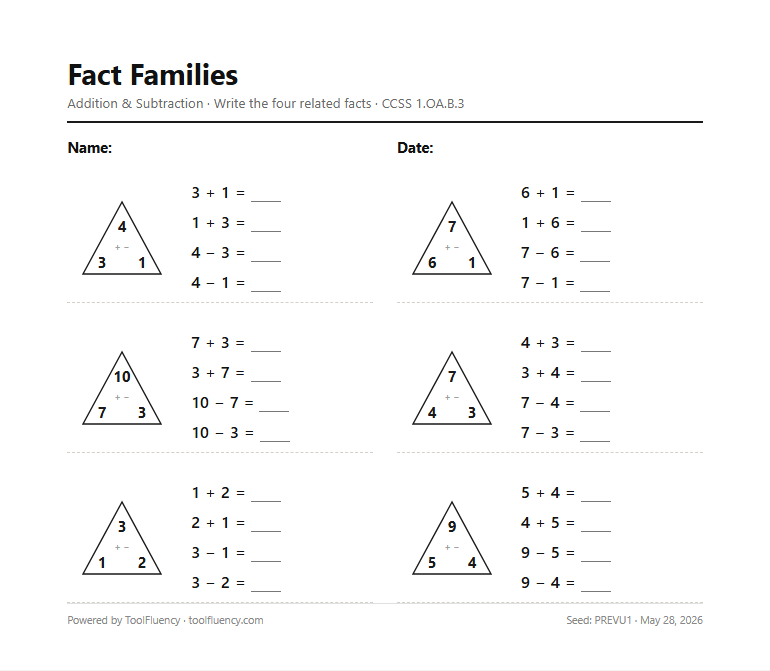
Teach subtraction alongside addition as inverse operations, not as a separate skill to memorise from scratch. A child who knows 8 + 5 = 13 already has 13 − 5 = 8 and 13 − 8 = 5 — that's the entire point of fact families. This roughly halves the memorisation load and builds the inverse-operation thinking that later powers algebra. Keep daily practice to 10–20 problems and lead with strategies (counting up to subtract, think-addition) before the written borrowing algorithm.
Pick the right subtraction worksheet
Grouped from first facts to multi-digit. Use the borrowing toggle on the main generator to match the exact skill you're practising.
 Start here
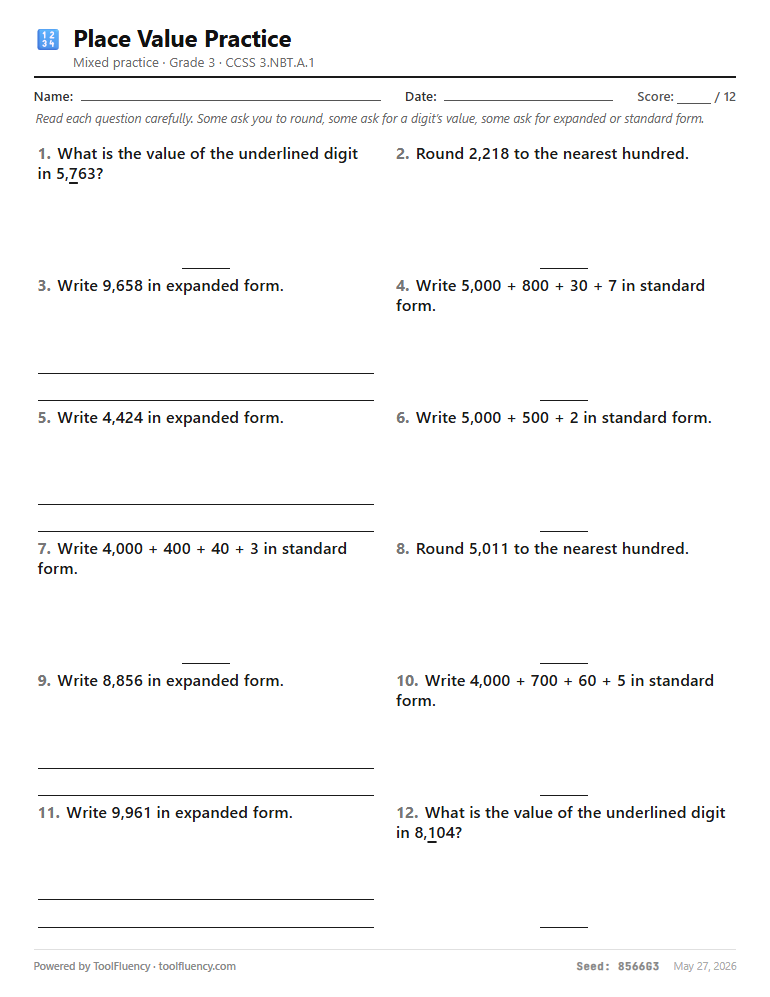
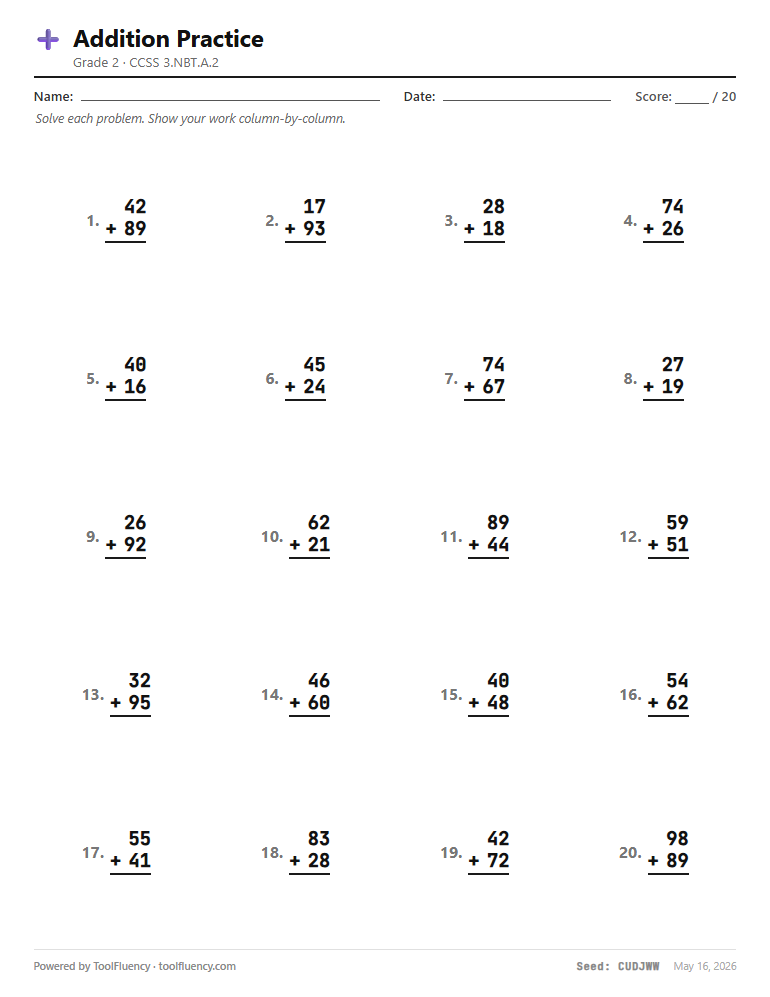
How subtraction is taught, K through Grade 4
The standard progression most curricula follow, and how the tools map to each stage.
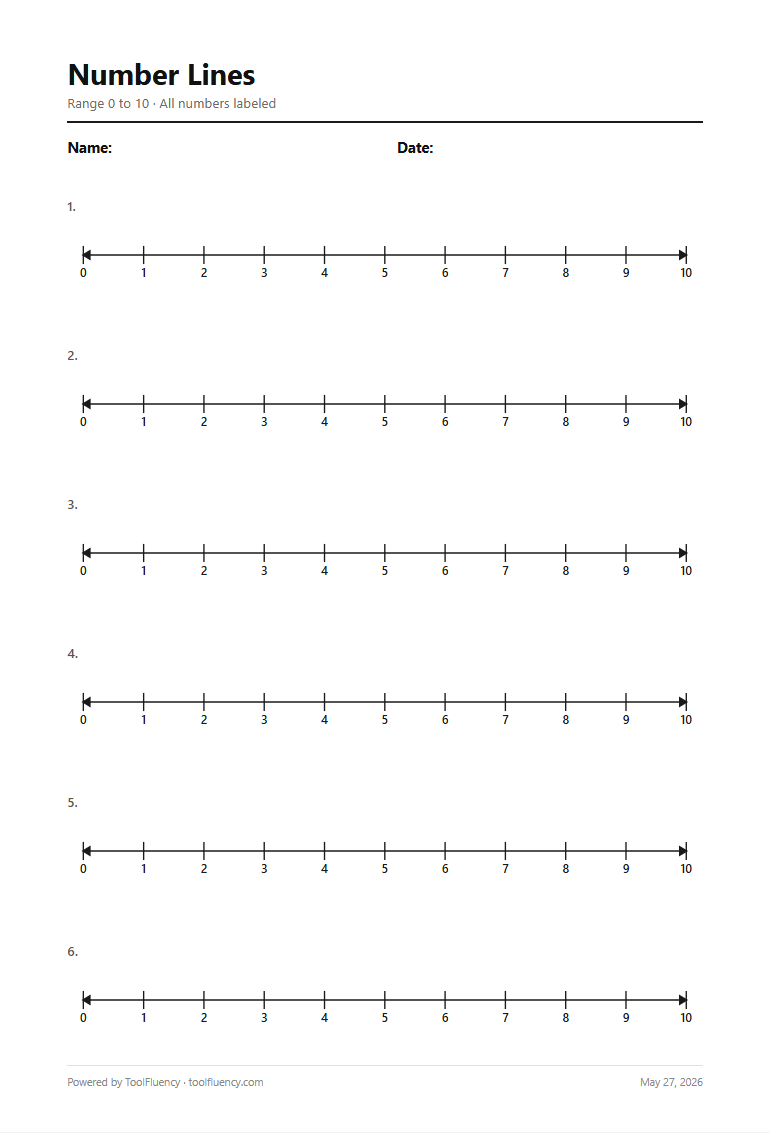
- Take-away within 10 (K–Grade 1). Children start with concrete "take away" (5 cookies, eat 2, how many left?). Use number lines to count back, and the subtraction generator at single-digit for fact practice. CCSS 1.OA.C.6.
- Think-addition & counting up (Grade 1–2). The key strategy: to solve 13 − 8, think "8 plus what makes 13?" This turns a hard subtraction into a known addition. Fact families are the tool — they show the addition and subtraction facts as one connected set.
- 2-digit, no borrowing (Grade 2). Subtract tens and ones separately when no regrouping is needed (47 − 23). This locks in place-value alignment before the harder borrowing step. Use the generator at 2-digit with borrowing off.
- Borrowing / regrouping (Grade 2–3). The conceptual leap: when the top digit is smaller, borrow a ten from the next column. Anchor it in expanded form so students see borrowing as renaming one ten as ten ones. Turn the borrowing toggle on so every problem requires it.
- Subtraction within 1000 (Grade 3). CCSS 3.NBT.A.2 — fluently subtract 3-digit numbers, including across zeros (the famous 300 − 147). The subtraction generator at 3-digit is the core homework tool. Reinforce with word problems.
- Multi-digit fluency (Grade 4). Larger numbers, more regroupings, and subtraction inside multi-step problems. Continue at 4-digit and lean on word problems for the multi-step standard (4.OA.A.3).
Common questions about subtraction worksheets
What parents and teachers ask first.